What SQMS No. 2 and SAS 146 Mean for Your EBP Practice
With the 2025 plan year behind us, now is the time to prepare for the 2026 plan year employee benefit plan (EBP) audits. The next round of EBP audits is the first to fall under two AICPA standards: SQMS No. 2, which governs engagement quality reviews (EQRs), and SAS 146, which makes the engagement partner responsible for quality on each audit. Both apply to audits of financial statements for periods beginning on or after Dec. 15, 2025.
While neither standard adds new EBP-specific audit procedures, both change how a firm manages, reviews, and documents the quality of each plan audit: who takes a second look at the file, when that look happens, and what the signing partner owns.
The updates to these standards point in one direction: the AICPA is focused on quality that each audit can demonstrate, not just a checklist of completed tests. Firms that finalize their review criteria, reviewers, and partner expectations before next season will begin 2026 plan year audits with less to build.
SQMS No. 1 turned quality into a risk question
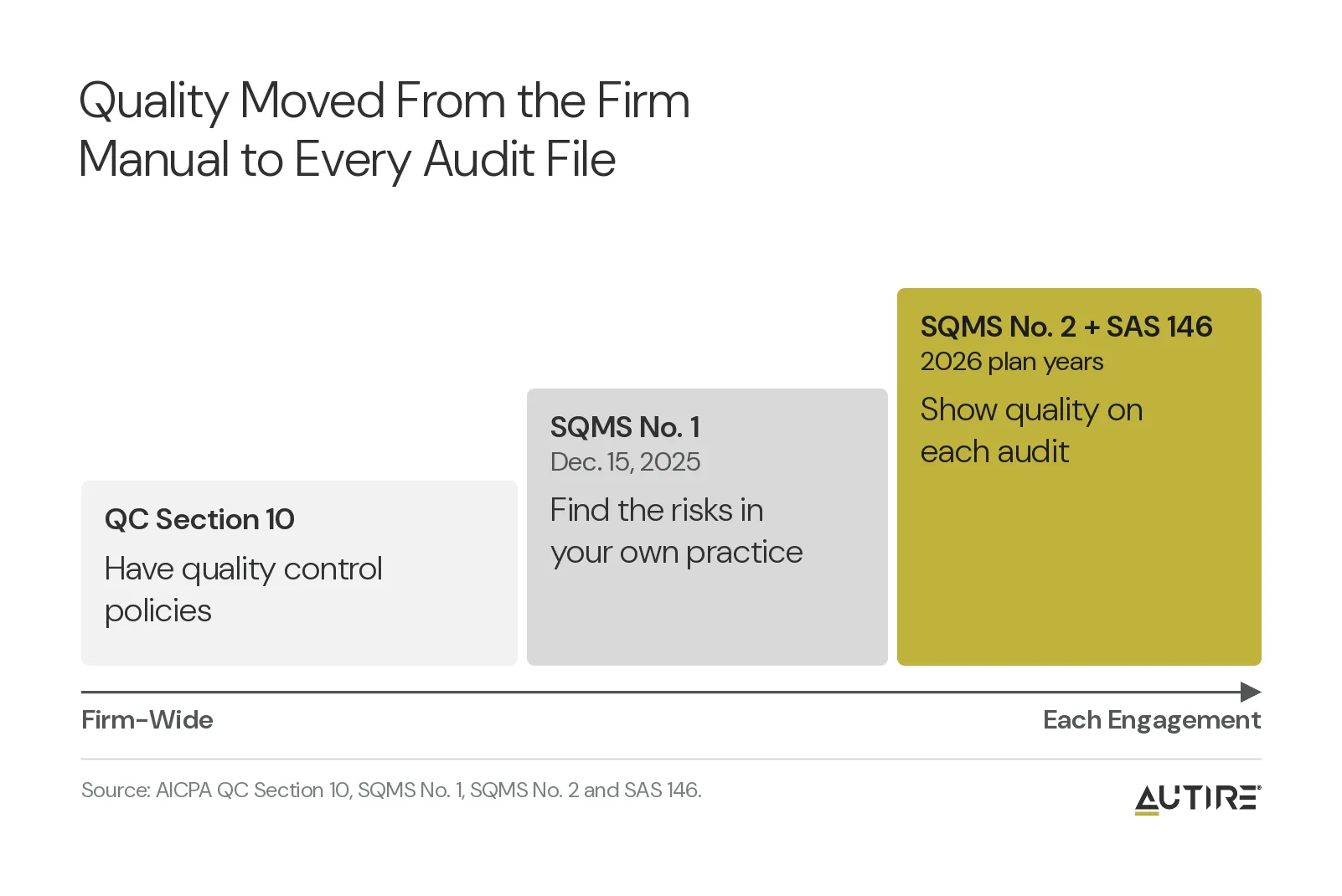
Before SQMS No. 1, firms followed QC section 10 (SQCS No. 8), a prescribed set of quality control policies and procedures. SQMS No. 1, A Firm’s System of Quality Management, replaced it with a risk-based question: where are the risks to quality in your practice, and what are you doing about them? Firms now document those risks and their responses, and leadership must evaluate the system at least annually. Systems had to be designed and implemented by Dec. 15, 2025, and the first evaluation is due by Dec. 15, 2026. For example, a firm might treat a plan it has audited for five years as lower risk than a first-year plan whose sponsor has no CFO or formal governance structure.
The Department of Labor’s November 2023 EBSA audit quality study shows why this matters for EBP audits: it found one or more major deficiencies in 30% of the 307 plan audits reviewed, down from 39% in 2015. Firms must write their risk criteria down, decide how to vet the tools, templates and methodology they rely on, and show that leadership evaluates the system each year. The AICPA also cites peer review results and regulator studies behind the standards, including overreliance on third-party materials that are not tailored to the firm.
What’s new for EBP audits for the 2026 plan year
SQMS No. 2: A Second Look at the Riskiest Plans
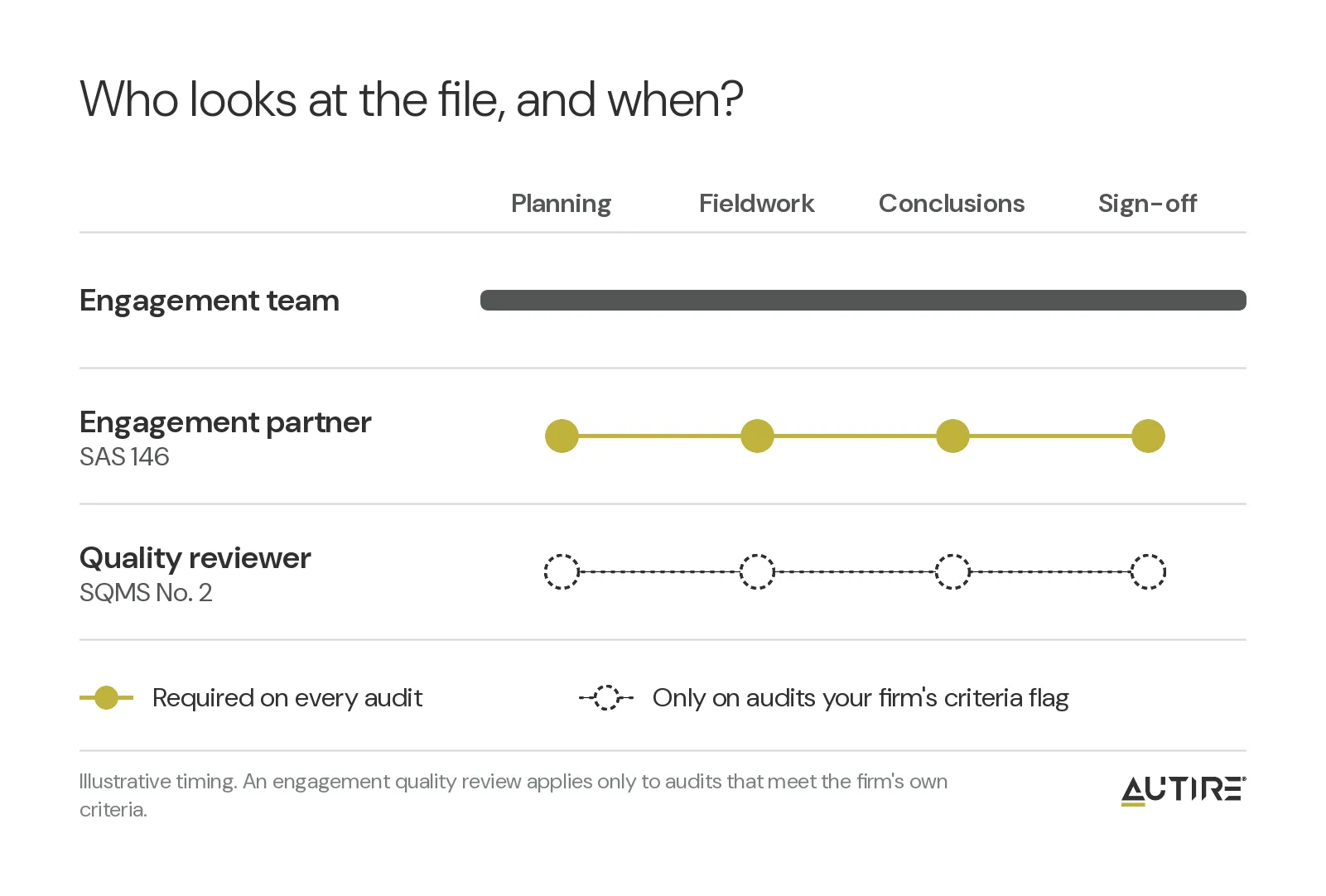
SQMS No. 2 gives the engagement quality review (EQR) its own standard. The reviewer was not on the engagement team and evaluates the team’s significant judgments and conclusions rather than rechecking work papers line by line. On an EBP audit, that might be how the team assessed risk after a recordkeeper change, how it evaluated the recordkeeper’s SOC 1 report or ERISA §103(a)(3)(C) certification, and how it concluded on exceptions in contributions and participant data.
Not every audit requires an EQR. Each firm decides which audits need an EQR, based on its own quality risks, unless law, regulation or other requirements call for one, and records the criteria in its quality management documentation. A firm might require one for first-year plans, high-risk plans, or plans that changed recordkeepers or other service providers during the year.
Where to start: before the first 2026 plan year audit, write the criteria, name who can review, and put review points on the engagement timeline. The reviewer can be internal or external, but needs the competence, time, authority and objectivity for the engagement, which can be hard for firms with small EBP practices. SQMS No. 2 requires threats to the reviewer’s objectivity to be eliminated or reduced to an acceptable level, so firms should have a policy for a former engagement partner moving into the EQR role on the same engagement. The review must happen at appropriate points, not only at the end, and the reviewer’s documentation belongs in the audit file.
SAS 146: The Signing Partner Owns Quality, Start to Finish
SAS 146, Quality Management for an Engagement Conducted in Accordance With GAAS, supersedes AU-C section 220 and puts the engagement partner in charge of quality on the audit.
SQMS No. 1 set quality expectations for the firm as a whole. SAS 146 applies them engagement by engagement: the partner signing each plan audit is responsible for managing and achieving quality on it, so the firm’s system is no longer the only place quality is accounted for. The partner must be involved throughout the engagement, not only at sign-off, and confirm before signing that the involvement was sufficient.
The partner can assign tasks to skilled team members, but the partner remains ultimately responsible, and some requirements must be fulfilled by the partner personally. Direction, supervision and review must fit the audit and the resources assigned to it, including staff experience, audit tools and templates. If those resources are insufficient or inappropriate for the plan, the partner has to act, whether through closer supervision, a staffing change or additional resources.
Where to start: at planning. Set who covers which areas and how closely first-year staff are supervised, review significant judgments as they arise, and document that it happened. SAS 146 uses the same resource categories as SQMS No. 1 (technological, intellectual and human), so the tools and templates named in your quality management documentation should match what the partner relies on in the file. The partner also has to review significant matters, significant judgments and formal written communications to management and those charged with governance.
Where EBP Audits Are Heading: From Checklists to Quality You Can Show
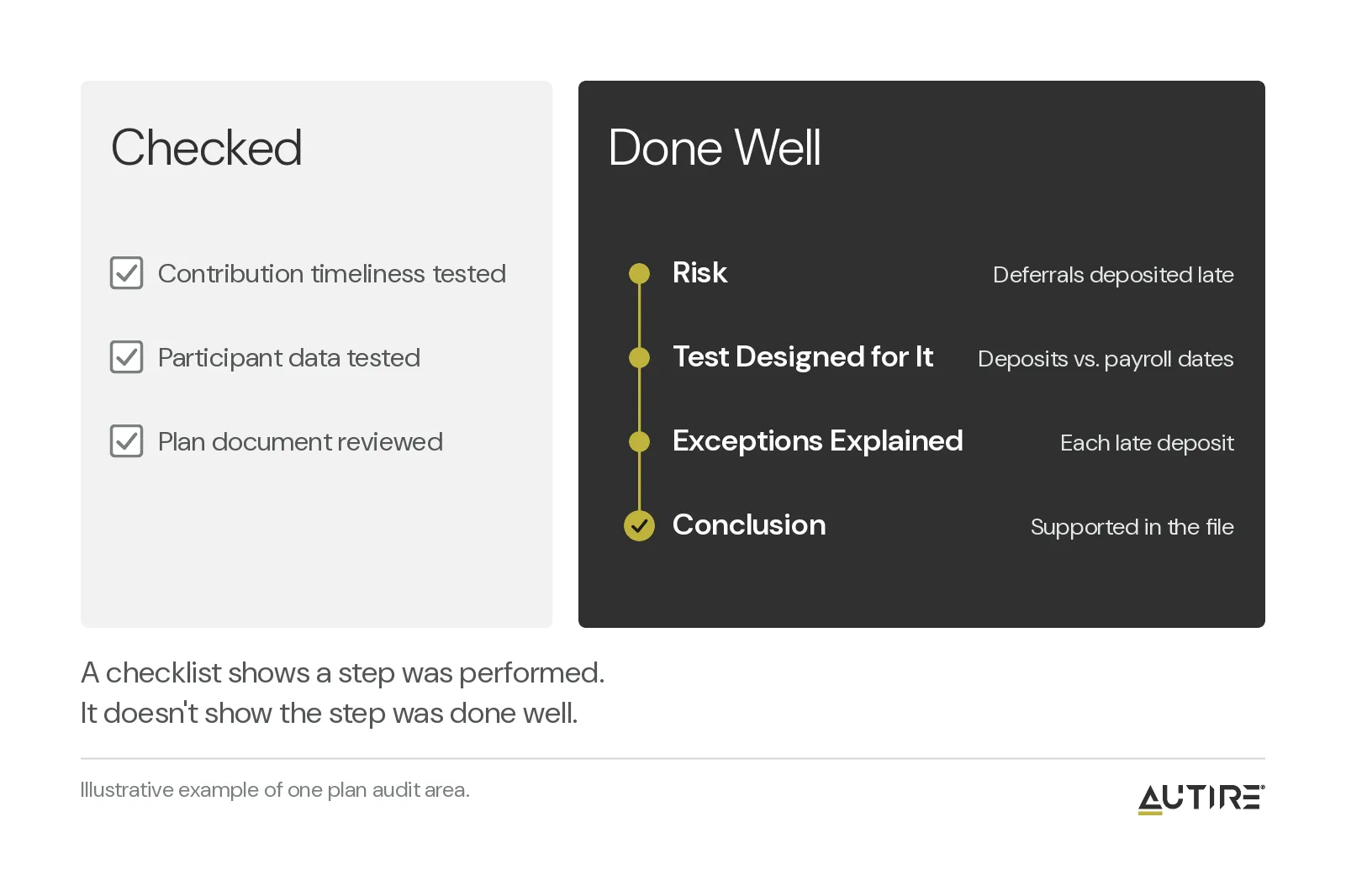
The latest changes in auditing standards show the profession shifting from policy to practice. While a traditional EBP audit checklist shows that an audit procedure was performed, it does not indicate whether it was done well. Successful firms must shift from asking “did we complete the procedures?” to “could an experienced auditor with no prior connection to this engagement follow our work and reach the same conclusion, on every file?” The standards require auditors to respond to the risks they assess, but they do not prescribe the tests, and test design is where quality varies. On EBP audits, that variation tends to show up in areas such as contributions, participant data and benefit payments, where the DOL study found its most common deficiencies.
Standards Built Into the Platform
In Autire, we’ve rebuilt the EBP audit process from the ground up so that standardized tests, review workflows and EBP-specific audit methodology are built into the platform. This means a firm that audits 10 plans starts from the same foundation as one that audits hundreds or thousands. Firms then evaluate and tailor that foundation to the firm’s own practice, configuring methodology, thresholds and risk logic once so the settings cascade to every engagement. We track changes to the AICPA standards each year and build them into the platform, so firms don’t have to carry each change alone.
Our methodology is examined by an independent CPA firm each year through a Quality Management Materials (QMM) examination performed under AICPA attestation standards. More than 120 CPA firms use Autire, and audits that took 100+ hours on average can take 30 or fewer. Across more than 7,000 audits to date, zero peer review or DOL findings have been attributed to Autire.
Frequently asked questions
What are the audit requirements for 401(k) and other employee benefit plans for the 2026 plan year?
For 2026 plan year audits of 401(k) and other employee benefit plans, the main changes are SQMS No. 2 and SAS 146, which apply to audits of financial statements for periods beginning on or after Dec. 15, 2025. SQMS No. 2 sets requirements for firm-determined engagement quality reviews of higher-risk audits, and SAS 146 makes the engagement partner responsible for quality throughout the audit.
Does every 401(k) or other EBP audit need an engagement quality review?
No. Each firm decides which audits need one, based on its own quality risks (unless law or regulation requires one), and records the criteria in its quality management documentation.
Who is responsible for quality on an EBP audit under SAS 146?
The engagement partner. SQMS No. 1 sets the quality system at the firm level, and SAS 146 applies it to each engagement, so the partner who signs the report is responsible for managing and achieving quality on that audit. The partner can assign tasks to skilled team members but remains responsible and must be involved throughout.
How should an EBP practice evaluate audit software and other practice aids under the new standards?
Treat them as resources under SQMS No. 1: the firm decides whether each tool, template and methodology is appropriate for its practice, and under SAS 146 the partner has to act if the resources assigned to an audit are insufficient or inappropriate. Look for practice aids the firm can configure to its own risks and thresholds, that are independently examined (a QMM examination), and that update promptly as the standards change. Then evaluate them: review the examination report’s scope, criteria and exceptions, confirm the aid fits the plans the firm audits, and keep evidence of the evaluation. Tool output is evidence to evaluate, not a conclusion, and the firm needs a way to add procedures and documentation when a plan is unusual.
About Autire
Built by CPAs for CPAs, Autire is a comprehensive SaaS platform designed to streamline and optimize the 401(k) audit process, transforming it from a time-consuming, error-prone task into an efficient, accurate, and profitable operation for CPA firms. As the industry’s only all-in-one, fully automated, standards-based EBP auditing solution, Autire features full population testing, automated risk assessment, and instant error detection, making audits faster, more reliable, and far less labor-intensive. With a focus on reducing audit fatigue, ensuring compliance, and boosting firm profitability, Autire helps modern CPA firms stay competitive in today’s demanding regulatory environment.
For more information or to schedule a demo, visit www.autire.com.